On August 22, 2026, a humanoid robot crossed the 100-meter finish line at Beijing’s National Speed Skating Oval, fell over, and caught fire. A firefighter put it out with an extinguisher while staff wiped foam off the track (Reuters photo coverage via Dawn). The same weekend, other robots at the 2nd World Humanoid Robot Games were carried off on stretchers, and a robot beat Usain Bolt’s 100m world record.
Both things are true at once, and that is the story. Humanoids are now fast enough to outrun the fastest human who ever lived, and fragile enough that finishing a sprint sometimes ends in flames. Two years of Chinese robot sporting events, the 2025 and 2026 World Humanoid Robot Games and the Beijing E-Town half-marathons, have produced the largest public dataset of humanoid hardware failures ever assembled. Thousands of robots, pushed to their limits, on camera, with the press watching.
Unitree Spring Festival Gala Robots —a Full Release of Additional Details — Unitree Robotics
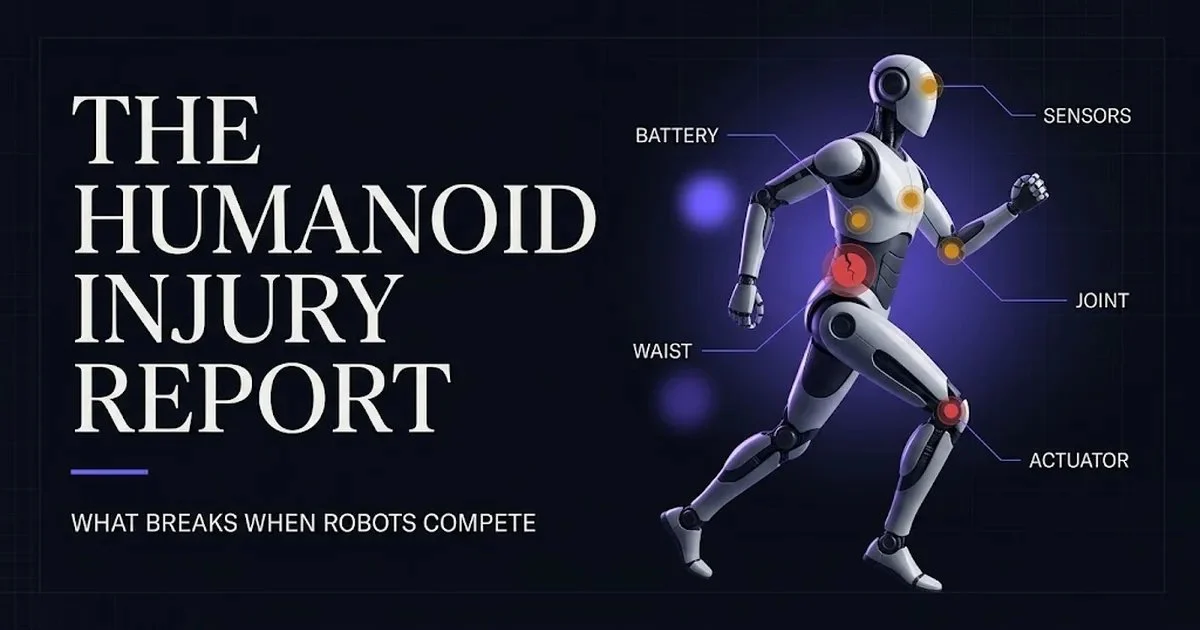
This is the injury report: what actually breaks, which subsystems fail, and why it matters for anyone who will own, deploy, or repair one of these machines.
The events, briefly
The 2026 World Humanoid Robot Games ran August 22–26 in Beijing, with 2,056 robots from 666 teams across 16 countries, quadruple the robot count of the inaugural 2025 edition (Yahoo Tech). The program covered 51 events: 30 competitive disciplines like sprinting, kickboxing, soccer, and high jump, plus 21 scenario-based trials such as fire rescue, power-tool assembly, and hotel service (Interesting Engineering).
The headline results were genuinely historic. A robot ran the 100m in 9.39 seconds, beating Bolt’s 9.58 human record from 2009 (AP via KIRO 7). The Tien Kung Ultra clocked 38.15 seconds over 400m, well inside Wayde van Niekerk’s 43.03 human record (Kyodo via Bangkok Post). A robot cleared 2.88m in the high jump against Javier Sotomayor’s 2.45m. For context: the winning 100m time at the 2025 games was 21.50 seconds. The field got more than twice as fast in one year.
And yet. Robots tripped, fell, broke apart, and burned. The failure footage went as viral as the records. For our purposes the failures are the more useful data.
The injury taxonomy
Across the 2025 half-marathon, the 2025 games, and the 2026 games, the same failure classes recur. Here is the field guide.
1. Deceleration trauma: the sprinter’s injury
The single most distinctive humanoid sports injury of 2026 is not falling while running. It is the inability to stop.
Race organizers place crash mats at the end of sprint lanes because slamming into a cushion is, for now, the standard braking method. Robot sprinters routinely finish by smashing into safety barriers (Yahoo Tech). One Unitree machine hit a top speed of 28.3 mph, failed to brake, veered off the track, and crashed into the trackside. The Tien Kung Ultra’s record-beating 9.32-second preliminary heat ended with the robot hitting the deceleration mat and catching fire (Kyodo).
The engineering reason is straightforward. Staying upright requires constant split-second balance computation; controlled deceleration from 28 mph on two legs multiplies that difficulty. Sprint control policies are trained to maximize forward speed, and reversing enormous momentum through knee and ankle actuators without pitching forward is a problem nobody has solved. Humans get braking for free from millions of years of evolved reflexes and compliant tissue. Robots get a mat.
The downstream damage: high-speed impacts concentrate load on the chest shell, arms, and, as the next section shows, the waist.
2. Structural failure at the waist
Days before the 2026 games opened, a training clip went viral: a robot sprinting down the indoor track fails to slow, hits the padded barrier, bends sharply at the waist, folds forward, and collapses with sparks flying (Interesting Engineering). Chinese social media captioned it, roughly, “ran too fast, couldn’t brake, broke its waist on the mat.”
The waist is a predictable weak point. It is the highest-torque joint in the torso, carries the full inertia of the upper body during any impact, and in most current designs is a single yaw-plus-pitch actuator assembly rather than the load-distributing column a human spine provides. When a 40–70kg machine traveling at sprint speed stops against a wall, the bending moment goes through that one joint. Waist actuator replacement is also among the more invasive repairs on current platforms, since the torso typically has to come apart.
3. Thermal events: overheating and fire
Fire made its competitive debut at these events. The August 22 incident, a robot burning on the track after finishing the 100m preliminaries while a firefighter extinguished it, was photographed by Reuters and Getty from multiple angles (Geo/Reuters). CBS reported robots catching fire during the games, plural (via KIRO 7).
Overheating short of fire is far more common. At the April 2025 Beijing E-Town half-marathon, the first race of its kind, many of the 21 robot entrants overheated and fell, and handlers resorted to cooling sprays mid-race to keep motors alive (event record, citing Guardian and Reuters reporting). Sustained locomotion pushes joint motors and drive electronics to thermal limits that demo videos never reach. A sprint stresses peak current; a half-marathon stresses heat dissipation for two-plus hours. Different event, different failure.
Lithium battery packs add the fire risk. A hard impact after a sprint combines a hot, heavily-drawn pack with mechanical shock, which is exactly the recipe battery engineers design against in EVs, on a platform young enough that crash-tested pack enclosures are not yet standard.
4. Battery exhaustion
Tien Kung Ultra, the eventual half-marathon winner at 2 hours 40 minutes, fell once during the race because its battery ran low, and needed multiple battery swaps to finish (race coverage). The event rules formally included battery-swap pit stops (AP via Euronews).
Note the failure mode: low battery did not mean the robot politely stopped. It fell. Voltage sag under load degrades actuator torque before the system shuts down, and a biped that loses torque mid-stride goes over. For owners, this maps directly to real-world risk: a humanoid at 8% charge is not a laptop at 8% charge. It is a machine that may fall on whatever is next to it.
5. Falls, and what one fall costs
Falls are the background radiation of every humanoid event. At the 2025 games, kickboxing robots fell when a kick missed, soccer robots tripped over the slightest contact, and stage performers toppled mid-dance and were carried off by staff (Smithsonian). In relay races, one observer noted a cascade effect: when one robot fell, others followed it down (News On Air). At the 2025 half-marathon, one robot collapsed at the starting gun and lay motionless for minutes; another slammed into a railing after a few strides (Al Jazeera).
What does a fall actually cost? The best public data point comes from a 2026 materials study on fall protection. Researchers ran repeated real-world fall tests on a PM01 humanoid and found that, unprotected, the robot suffered severe hardware damage after just one or two dynamic falls: cracked structural housings, damaged circuit boards, and jammed or broken actuators. Fitted with soft protective material, the same robot survived more than thirty consecutive falls without visible damage (arXiv 2601.02857).
Read that again as an owner: one or two bad falls can mean board-level and actuator-level repairs. This is why fall-recovery research treats getting up as a core skill (arXiv 2502.12152), and why the aftermarket for protective padding will exist before the aftermarket for almost anything else.
6. Navigation and control faults
Not every crash starts with physics. Some start with perception. Half-marathon robots drifted off line because IMU-only navigation accumulated error without visual correction, and at least one entrant spun in circles off the start before hitting a wall (post-race technical analysis). Mundane mechanical failures joined in: heads working loose and shoes coming off, fixed trackside with duct tape (event record).
The 2026 games made this class of failure more visible by design. Several track events switched from remote-controlled to fully autonomous, and observers noted this year’s runners had more trouble navigating than last year’s human-piloted machines (Yahoo Tech). Take away the human in the loop and the perception stack becomes the weakest link. This is the honest preview of unsupervised deployment.
7. Human collateral
One under-reported category: the humans. At the 2025 half-marathon, a robot crashed into a railing and took its own handler down with it (Business Insider). Every robot in that race required human support, and support staff work inside the fall radius of a 40kg-plus machine. As humanoids enter homes and workplaces, “who gets hurt when it falls” becomes a liability question, not a blooper reel.
Why 2026 broke more robots than 2025
Counterintuitively, the robots got better and the crashes got worse, for three compounding reasons. Speeds more than doubled, so impact energy roughly quadrupled (kinetic energy scales with the square of velocity). Event rules removed human pilots from several disciplines, exposing raw autonomy. And the field quadrupled in size, so more machines were pushed past their limits in public.
This is what a maturing industry stress-testing itself looks like. Experts quoted after the viral waist-snap crash made the point directly: competitions exist to expose weaknesses in perception, planning, balance, and control before robots reach real deployments (Interesting Engineering). The failure data is the product.
What this means if you own, or will own, a humanoid
The competition injuries map cleanly onto the repair categories that will define humanoid ownership:
Waist and leg actuators take the worst structural loads and are the most invasive to replace. Thermal management limits sustained work; a robot that overheats in a half-marathon will also overheat in an eight-hour warehouse shift without duty-cycle management. Battery health is a safety issue, not just a runtime issue, because torque sag precedes shutdown. Falls are the universal damage source, and per the PM01 study, one or two of them can reach circuit boards and actuators. Perception faults cause crashes that look mechanical but are software.
None of this is covered well by current warranties, most of which are voided by opening the machine and require shipping to the manufacturer for service. There is no third-party repair network for humanoids yet. That gap is exactly what we track in our Fix section, which documents real, sourced failure reports and troubleshooting for specific robots, starting with the Unitree G1 and Unitree Go2.
If you own a humanoid, or plan to, and want to be first in line when in-home repair service reaches your city, join the repair waitlist. Tell us your city and your robot; we’re building the service map from demand.
The robots will keep getting faster. The 2026 E-Town half-marathon already saw a robot beat the human world record barely a year after most of the field failed to finish at all. What won’t change soon: the machine that can outrun Usain Bolt still can’t stop without hitting a wall, and somebody has to fix what breaks.