2026年8月22日,一个人形机器人在北京国家速滑馆冲过100米终点线后倒下并起火。一名消防员用灭火器将其扑灭,工作人员则擦拭着跑道上的泡沫(经由 Dawn 发布的 Reuters 现场照片)。同一个周末,其他机器人在第二届世界人形机器人运动会上被用担架抬走,而一款机器人打破了博尔特(Usain Bolt)的100米世界纪录。Reuters photo coverage via Dawn)。同一个周末,其他机器人在第二届世界人形机器人运动会上被用担架抬走,一款机器人打破了博尔特的100米世界纪录。
这两种情况同时存在,这就是故事的全貌。人形机器人现在的速度已经超过了人类历史上跑得最快的人,但同时也脆弱到有时完成冲刺反而以起火告终。两届中国机器人体育赛事——2025年和2026年世界人形机器人运动会以及北京亦庄半程马拉松——产生了有史以来最大规模的人形机器人硬件故障公开数据集。数千台机器人被推向极限,全程被镜头记录,媒体全程关注。
Unitree Spring Festival Gala Robots —a Full Release of Additional Details — Unitree Robotics
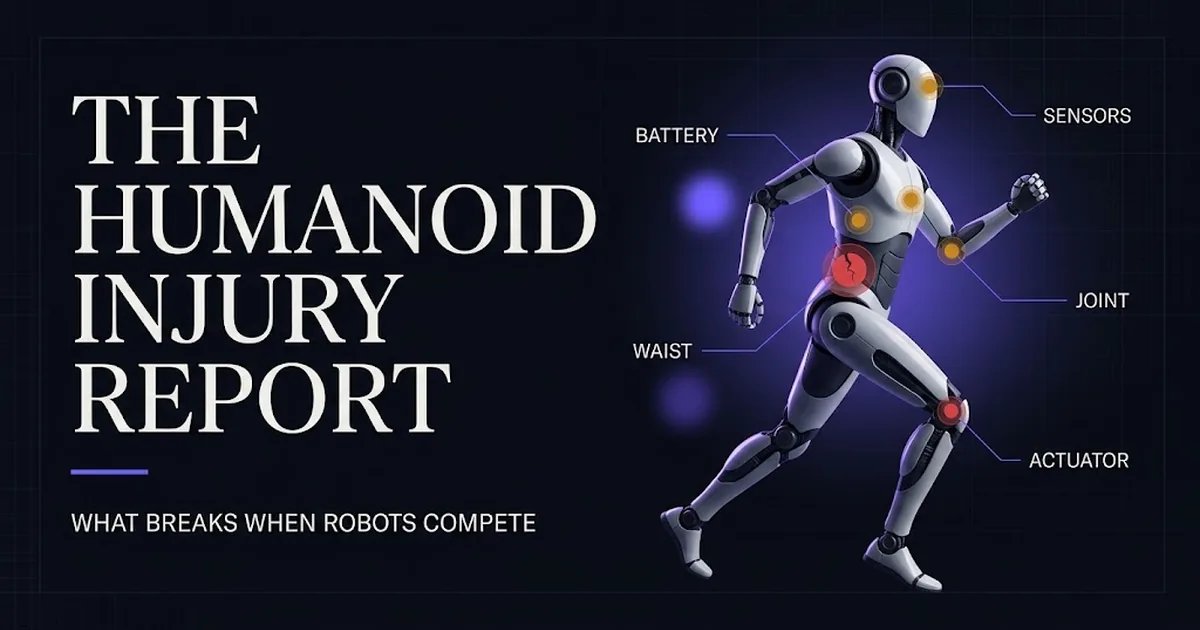
这就是损伤报告:哪些部件真正会损坏,哪些子系统会失效,以及这对任何将拥有、部署或维修这些机器的人为何重要。
赛事概览
Unitree H1/H1-2的10 m/s冲刺速度成就 2026 World Humanoid Robot Games 本届赛事于8月22日至26日在北京举办,汇聚了来自16个国家的666支团队的2056台机器人,数量是第一届2025年赛事的四倍(Yahoo Tech)。赛事涵盖51个项目:30个竞技项目包括短跑、搏击、足球和跳高,以及21个场景模拟测试如火灾救援、电动工具组装和酒店服务(Interesting Engineering)。Yahoo Tech)。赛事涵盖51个项目:30个竞技项目包括短跑、搏击、足球和跳高,以及21个场景模拟测试如火灾救援、电动工具组装和酒店服务。Interesting Engineering).
)。主要赛果确实具有历史意义。一台机器人以9.39秒完成100米,打破了博尔特2009年9.58秒的人类纪录(AP via KIRO 7)。Tien Kung Ultra 以38.15秒完成400米,远低于韦德·范尼科尔克(Wayde van Niekerk)43.03秒的人类纪录(Kyodo via Bangkok Post)。一台机器人在跳高项目中越过2.88米,而哈维尔·索托马约尔(Javier Sotomayor)的人类纪录为2.45米。作为对比:2025年运动会的100米冠军成绩为21.50秒。该领域在一年内提速了一倍多。AP via KIRO 7)。Tien Kung Ultra 跑出38.15秒的400米成绩,远低于韦德·范尼科尔克的43.03秒人类纪录。Kyodo via Bangkok Post)。一台机器人在跳高项目中越过2.88米,而哈维尔·索托马约尔的人类纪录为2.45米。作为对比:2025年运动会的100米冠军成绩为21.50秒。该领域在一年内提速了一倍多。
然而,机器人绊倒、摔倒、散架、燃烧。失败视频和纪录一样病毒式传播。对我们而言,失败是更有价值的数据。
损伤分类
在2025年半程马拉松、2025年运动会和2026年运动会上,同样的故障类型反复出现。以下是完整指南。
1. 减速创伤:短跑运动员的伤痛
2026年最具特色的人形机器人运动损伤并非跑步时摔倒,而是无法停止。
赛事组织者在短跑道尽头放置缓冲垫,因为目前撞向缓冲垫是标准的制动方法。机器人短跑选手通常以猛撞安全护栏完成比赛()。一台 Unitree 机器人的最高速度达到28.3英里/小时,未能刹车,偏离赛道,撞向赛道边。Tien Kung Ultra 打破纪录的9.32秒预赛中,机器人在撞上减速垫后起火(Kyodo)。Yahoo Tech)。Kyodo).
)。工程原因很简单。保持直立需要持续的即时平衡计算;从28英里/小时在两条腿上受控减速会使难度倍增。冲刺控制策略被训练为最大化前进速度,而在不前倾的情况下通过膝关节和踝关节执行器反转巨大动量是一个尚未解决的问题。人类依靠数百万年进化出的反射和柔顺组织免费获得制动能力。机器人只能靠一块垫子。
后续损害:高速撞击将载荷集中于胸部外壳、手臂,以及下一节将讨论的腰部。
2. 腰部结构失效
2026年运动会开幕前几天,一段训练视频走红:一台机器人在室内跑道上冲刺,未能减速,撞上缓冲护栏,在腰部剧烈弯曲,向前折叠,火花四溅地倒下()。中国社交媒体的配文大意是:"跑太快了,刹不住,腰撞在垫子上断了。"Interesting Engineering)。
腰部是一个可预见的弱点。它是躯干中扭矩最大的关节,在任何撞击中承受上半身全部惯性,而且在大多数当前设计中是一个单一的偏航加俯仰执行器组件,而非人类脊柱提供的负载分配柱。当一台重40-70公斤的机器以冲刺速度撞墙时,弯矩通过这一个关节传递。腰部执行器的更换也是当前平台上最具侵入性的维修之一,因为通常需要拆卸整个躯干。
3. 热事件:过热和起火
火焰在这些赛事中首次亮相。8月22日的事件——一台机器人在完成100米预赛后在赛道上燃烧,消防员将其扑灭——被 Reuters 和 Getty 从多个角度拍摄(Geo/Reuters)。CBS 报道了多起机器人在运动会期间起火的事件(via KIRO 7)。Geo/Reuters)。CBS 报道了多起机器人在运动会期间起火的事件。via KIRO 7).
)。远未达到起火程度的热过载更为常见。2025年4月首届北京亦庄半程马拉松上,21台参赛机器人中许多因过热而摔倒,工作人员不得不在比赛中途使用冷却喷雾来维持电机运转(事件记录,引用 Guardian 和 Reuters 报道)。持续运动将关节电机和驱动电子设备推向热极限,这是演示视频从未达到的状态。冲刺考验峰值电流;半程马拉松则考验两小时以上的散热能力。不同的赛事,不同的故障。event record, citing Guardian and Reuters reporting)。持续运动将关节电机和驱动电子设备推向热极限,这是演示视频从未达到的状态。冲刺考验峰值电流;半程马拉松则考验两小时以上的散热能力。不同的赛事,不同的故障。
锂离子电池组增加了起火风险。冲刺后的硬撞击将一个发热、深度放电的电池组与机械冲击结合,这正是电池工程师在电动汽车中设计防护的配方,但这个平台还太年轻,碰撞测试的电池组外壳尚未成为标准。
4. 电池耗尽
Tien Kung Ultra, the eventual half-marathon winner at 2 hours 40 minutes, fell once during the race because its battery ran low, and needed multiple battery swaps to finish 天工Ultra,最终以2小时40分钟的成绩赢得半马冠军,在比赛中因电池电量耗尽而摔倒一次,需要多次更换电池才能完赛race coverage). The event rules formally included battery-swap pit stops 赛事规则正式将电池更换pit stop纳入其中AP via Euronews).
Note the failure mode: low battery did not mean the robot politely stopped. It fell. Voltage sag under load degrades actuator torque before the system shuts down, and a biped that loses torque mid-stride goes over. For owners, this maps directly to real-world risk: a humanoid at 8% charge is not a laptop at 8% charge. It is a machine that may fall on whatever is next to it.
5. Falls, and what one fall costs
Falls are the background radiation of every humanoid event. At the 2025 games, kickboxing robots fell when a kick missed, soccer robots tripped over the slightest contact, and stage performers toppled mid-dance and were carried off by staff (Smithsonian 史密森尼). In relay races, one observer noted a cascade effect: when one robot fell, others followed it down (News On Air 新闻广播). At the 2025 half-marathon, one robot collapsed at the starting gun and lay motionless for minutes; another slammed into a railing after a few strides (Al Jazeera 半岛电视台).
What does a fall actually cost? The best public data point comes from a 2026 materials study on fall protection. Researchers ran repeated real-world fall tests on a PM01 humanoid and found that, unprotected, the robot suffered severe hardware damage after just one or two dynamic falls: cracked structural housings, damaged circuit boards, and jammed or broken actuators. Fitted with soft protective material, the same robot survived more than thirty consecutive falls without visible damage (arXiv 2601.02857).
Read that again as an owner: one or two bad falls can mean board-level and actuator-level repairs. This is why fall-recovery research treats getting up as a core skill (arXiv 2502.12152), and why the aftermarket for protective padding will exist before the aftermarket for almost anything else.
6. Navigation and control faults
Not every crash starts with physics. Some start with perception. Half-marathon robots drifted off line because IMU-only navigation accumulated error without visual correction, and at least one entrant spun in circles off the start before hitting a wall (post-race technical analysis). Mundane mechanical failures joined in: heads working loose and shoes coming off, fixed trackside with duct tape (event record 赛事记录).
The 2026 games made this class of failure more visible by design. Several track events switched from remote-controlled to fully autonomous, and observers noted this year's runners had more trouble navigating than last year's human-piloted machines ( 2026年大赛刻意让这类故障更加显眼。几个赛道项目从遥控操作转为全自动,观测者注意到今年的跑步机器人比去年的人类操控机器人在导航方面遇到更多困难Yahoo Tech). Take away the human in the loop and the perception stack becomes the weakest link. This is the honest preview of unsupervised deployment.
7. Human collateral
One under-reported category: the humans. At the 2025 half-marathon, a robot crashed into a railing and took its own handler down with it (Business Insider). Every robot in that race required human support, and support staff work inside the fall radius of a 40kg-plus machine. As humanoids enter homes and workplaces, "who gets hurt when it falls" becomes a liability question, not a blooper reel. 那场比赛中每台机器人都需要人工支援,而工作人员在40多公斤机器人的跌落范围内作业。随着人形机器人进入家庭和工作场所,"机器人摔倒时谁会受伤"成为一个责任问题,而不是搞笑片段
Why 2026 broke more robots than 2025
Counterintuitively, the robots got better and the crashes got worse, for three compounding reasons. Speeds more than doubled, so impact energy roughly quadrupled (kinetic energy scales with the square of velocity). Event rules removed human pilots from several disciplines, exposing raw autonomy. And the field quadrupled in size, so more machines were pushed past their limits in public.
This is what a maturing industry stress-testing itself looks like. Experts quoted after the viral waist-snap crash made the point directly: competitions exist to expose weaknesses in perception, planning, balance, and control before robots reach real deployments (Interesting Engineering). The failure data is the product.
What this means if you own, or will own, a humanoid
The competition injuries map cleanly onto the repair categories that will define humanoid ownership:
Waist and leg actuators take the worst structural loads and are the most invasive to replace. Thermal management limits sustained work; a robot that overheats in a half-marathon will also overheat in an eight-hour warehouse shift without duty-cycle management. Battery health is a safety issue, not just a runtime issue, because torque sag precedes shutdown. Falls 摔倒 are the universal damage source, and per the PM01 study, one or two of them can reach circuit boards and actuators. Perception faults cause crashes that look mechanical but are software.
None of this is covered well by current warranties, most of which are voided by opening the machine and require shipping to the manufacturer for service. There is no third-party repair network for humanoids yet. That gap is exactly what we track in our Fix section Fix 板块, which documents real, sourced failure reports and troubleshooting for specific robots, starting with the Unitree G1 和 Unitree Go2.
If you own a humanoid, or plan to, and want to be first in line when in-home repair service reaches your city, join the repair waitlist. Tell us your city and your robot; we're building the service map from demand. 请告诉我们您的城市和您使用的机器人;我们正在从需求中构建服务地图
The robots will keep getting faster. The 2026 E-Town half-marathon already saw a robot beat the human world record barely a year after most of the field failed to finish at all. What won’t change soon: the machine that can outrun Usain Bolt still can’t stop without hitting a wall, and somebody has to fix what breaks.